
What Fulton County Deed Records Convey
A recorded deed names the parties. It also states the interest described in the instrument, and it identifies the land presented for recording. It can carry more. An execution date, a recording date, consideration language, a return address, a preparer, an instrument number, or a book and page may all appear. Deed type shapes the reading. A quitclaim and a warranty deed do different work. Recording alone never turns either one into a guarantee of good title.
| Deed Type | What It Does | Common Use |
|---|---|---|
| Warranty deed | Conveys the stated estate with covenants expressed in the instrument | Ordinary arms-length transfers |
| Quitclaim deed | Conveys whatever interest the grantor has without promising its extent | Family transfers and interest cleanup |
| Personal representative, executor, or trustee deed | Conveys through a fiduciary acting under stated authority | Estate or trust administration |
| Sheriff’s or commissioner’s deed | Documents a transfer following an authorized sale or proceeding | Foreclosure, partition, or court-connected transfer |
| Tax deed | Documents a tax-sale-related conveyance after statutory steps | Severely delinquent property |
| Correction deed | Corrects a stated defect or error in an earlier conveyance | Name or description corrections |
Mortgages, mechanic's liens, lis pendens, covenants, easements, and releases sit beside deeds in the index because they touch the same land trail. None is an ordinary conveyance. Read the document type and the image itself. The Recorder's classification decides how each instrument surfaces in a property search.
Tapestry or Laredo for Fulton Deed Research
The Fulton County Recorder online-records page presents two vendor routes into the deed index. Tapestry suits occasional searching. A search costs $8.95, plus $1 per printed page. Laredo serves recurring users. Its plans run $60 monthly for 250 minutes, $120 for 1,000 minutes, $240 for 3,000 minutes, and $300 for unlimited use, with $1 per-page printing, monthly billing, and setup through the Recorder at 574-223-2914.
| Route | Access model | Verified charge | Practical fit |
|---|---|---|---|
| Tapestry | Pay per search | $8.95/search plus $1/printed page | One deed or occasional chain question |
| Laredo | Monthly minutes | $60, $120, $240, or $300 tier; $1/page | Repeated or professional searching |
| Recorder counter/request | Office copy | $1/page; most direct deed copies reported as $2–$3 | Known instrument or custodian copy |
The official Recorder access screen lists both vendor options. The county also links a third-party land-record route carrying an availability and security disclaimer.
Record the vendor, search date, query, and instrument reference. Another researcher can then reproduce the search.
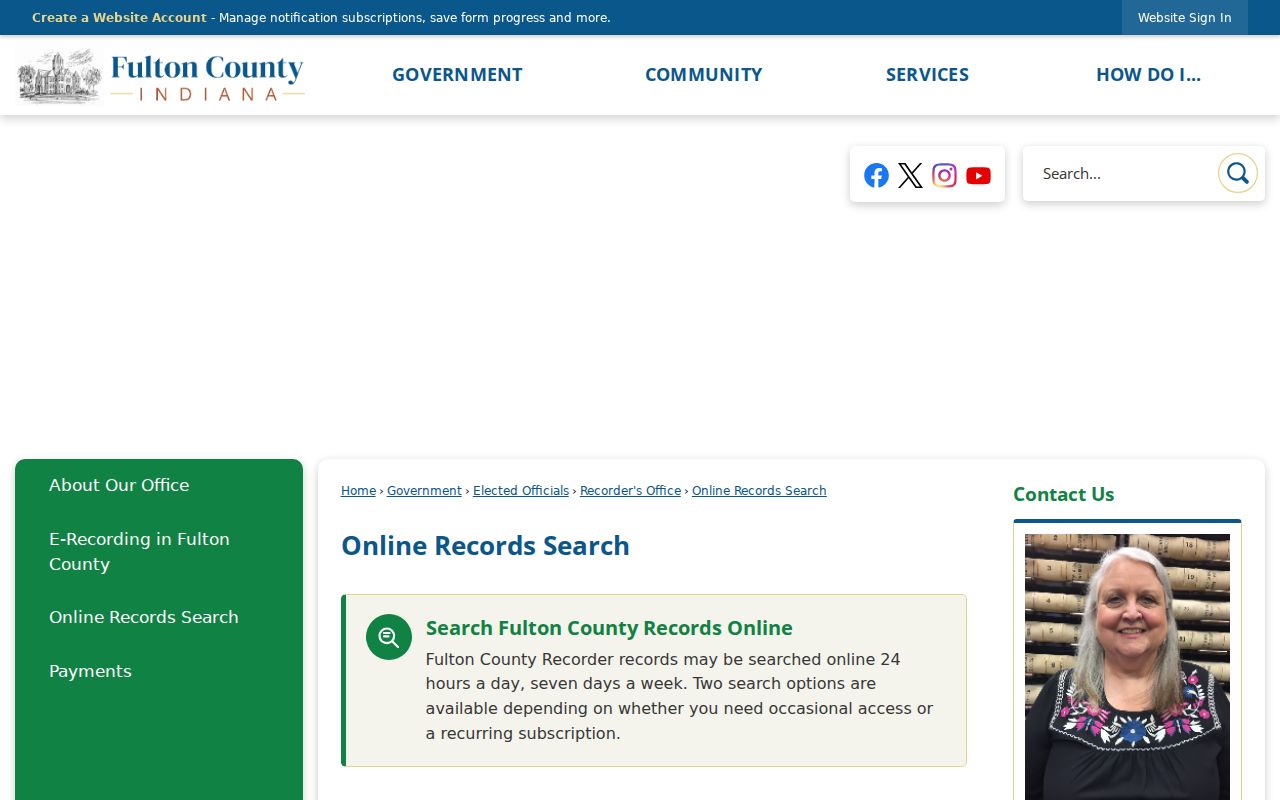
Fees and setup details change. The Recorder's own page remains the authoritative source for current pricing, even when a vendor interface shifts on its own.
Fulton’s 1988 Imaging Line Has Two Older-Coverage Descriptions
Indexing and images are complete from January 1, 1988 forward, the Recorder says. Older coverage gets described two ways. Newer material says deeds reach to 1942. A Recorder FAQ dates them to 1960 and says digitization of older records continues. Neither statement should be blended into a false cutoff.
For a pre-1988 deed, try the index first. Ask the Recorder what has been imaged for the year and instrument series you need. An empty name search from the 1940s or 1950s does not prove the absence of a conveyance. Paper fills the gap. Deed books, grantor and grantee indexes, tract books, and microfilm carry the chain where the web index stops. Note: Confirm the year, series, and image status with staff before paying for a broad online search.
Walk Fulton’s Grantor-Grantee Index Backward
A name index organizes conveyances by giver and receiver. Start from a solid current parcel and the newest deed that touches it. Search the variants exactly as each document spells them: initials, spouses, estates, trustees, business names, and "et al." A tax-card spelling is only a lead.
- Use the WTHGIS instrument number or displayed current name to find the acquisition deed, usually with the current owner as grantee.
- Open the image and capture every grantor, grantee, instrument type, recording date, legal-description reference, and related instrument.
- Search the grantor as a grantee in an earlier period to locate that party’s acquisition.
- Compare the legal description at every step; do not follow a same-name person onto unrelated land.
- Repeat to the online limit, then switch to deed books, reverse indexes, tract material, or microfilm.
- Grantor
- The party giving or conveying the interest.
- Grantee
- The party receiving the interest described.
- Chain of title
- The connected sequence of conveyances and related instruments affecting the same land.
- Book/page
- A volume-and-page reference used for recorded material.
- Instrument number
- A unique recording reference, especially useful for linking a parcel card to a newer filing.
Fields to Save from a Fulton Deed Index
The vendor's field list is live, not a fixed form. Do not assume filters. In practice, save the exact party spelling. Save the grantor or grantee role, the document type, and the instrument number. Also record the recording date, and the book and page if shown. Image availability matters too. Record the parcel or legal-description clue and any related instrument. Bracket search dates around the likely transaction rather than sweeping every year at paid-search rates.
| Party and role | Who gave and received the interest; keep all names and capacity terms |
|---|---|
| Document type | The index classification that controls interpretation and retrieval |
| Recording reference | Instrument number or book/page used to order the document |
| Recording date | Public filing order, distinct from the signature or closing date |
| Image status | Whether the document can be viewed or printed through that route |
| Land clue | Parcel, lot/block, addition, or metes-and-bounds reference tying the name to the tract |
Start with a broad parcel lookup. The Fulton County property search workflow captures the owner and instrument keys before you enter the paid recorder route.
Fulton County Deeds Follow Indiana Recording Rules
The Recorder requirements are strict. They demand a legible, notarized instrument, a legal description, a prepared-by statement under IC 36-2-11-15, a Social Security number redaction affirmation, and a physical grantee address under IC 32-21-2-3. Transfer documents also need Auditor and Assessor endorsements under IC 36-2-11-14.
Smaller defects can stall a filing too. Margin problems, copy stamps, fees, name mismatches, powers of attorney, mechanic's liens, exhibits, and notary errors can all block acceptance. That matters to a chain researcher. An unsigned draft, a rejected filing, or a private agreement is not a recorded conveyance, and an instrument number proves filing rather than validation of every claim inside.
Fulton Deed Books Reach to the County’s Beginning
The Indiana State Library Fulton microfilm finding aid documents a tract book beginning in 1834. Deed books and indexes start in 1836. Sheriff Deeds cover 1872 through 1933. Together these series offer a genuine pre-digital route when the web index ends, especially for nineteenth-century farms, platted town lots, and transfers that changed parcel identifiers long before WTHGIS. Early records reach the county's beginning.
Work series by series. Find the likely party and period in a grantor or grantee index, copy the deed-book volume and page it cites, retrieve that page, and compare its full legal description against the next transfer. The State Library's Fulton map collection helps too. It holds an 1883 atlas, a 1920 owner map, later plat books, Lake Manitou materials, and city street maps. Maps are strong correlation evidence. They do not replace the deed. Note: Preserve both the historical name spelling and the modern parcel key; either one may be the only bridge across a changed description.
A $100 Deed Mailer Versus a $2–$3 County Copy
Some companies mail Fulton County homeowners an offer of an "official deed" for more than $100. The Fulton County Recorder considers these solicitations a waste. A direct copy costs $1 per page. Most deeds total $2–$3. Before paying a mailer, identify the instrument in the official index and ask the Recorder about the current copy price.
This comparison concerns copies, not title. A plain copy answers a research question cheaply, while a formal proceeding may require a certified copy instead. Ask the custodian which copy form certification requires. DD-214 military records follow separate restrictions, even though veteran recording and eligible copies are free.
Property Fraud Alert Watches Names, Not Title
Fulton County offers a free Property Fraud Alert. The service checks registered names against new recordings and notifies by email, phone, or text. Registration allows three names per phone number or four per email. The alert can flag a filing fast. It neither blocks recording nor proves fraud. Verify the instrument with the Recorder first. Compare the parties and the land description, then report suspected problems through the proper office. Name variants matter. Register the spellings most likely to appear in the index, and use alerts as a prompt to check deed records periodically rather than a substitute for them.
Order a Fulton County Deed Copy
Once you know the instrument number or book and page, getting a copy is straightforward. Pull the image online if one is available. Or contact the Fulton County Recorder at 125 E. 9th Street, Suite 120, Rochester, IN 46975, 574-223-2914. Office hours run Monday through Friday, 8 a.m.–4 p.m. Have the details ready: instrument number or book/page, the party names, an approximate recording date, the document type, and a land description. Staff can tell you the current fee. They can also advise whether a plain or certified copy suits your purpose. You can arrange pickup or mail delivery.
Deeds that are not online can still be reviewed in person. They can also be requested by mail. Another option is a public-records request that identifies the record with reasonable particularity. Indiana's Access to Public Records Act, IC 5-14-3, guarantees inspection and copying of public agency records, subject to exemptions. It does not obligate staff to assemble a custom chain of title. The Recorder states plainly that the office does not perform title searches.
Recorded, not guaranteed. Fulton County deed records show instruments accepted for recording. They are not a title opinion, may not reveal unrecorded interests, and do not certify that the index chain is complete.