
Trace Fulton County Former Owners
Every chain starts with the newest deed and steps back in time. Each seller becomes the buyer in an older instrument. In Fulton County, former owners live in the Recorder's grantor and grantee indexes rather than in the assessor's current name alone. That is why the parcel search is only a starting point. Keep the legal description, document number, and exact party spelling with every match. Streets get renamed and parcel systems change. The recorded land description is built to carry the same tract across decades.
| Source | Years It Covers | Where Held | What It Shows |
|---|---|---|---|
| Recorder online index and images | Complete from Jan. 1, 1988; deeds described as reaching 1942 | Tapestry or Laredo | Indexed parties, instrument data, and available images |
| Older deed indexes and books | Recorder FAQ also describes deeds from 1960 and older indexing | Recorder office | Earlier former owners beyond consistent online coverage |
| State Library microfilm | 1834/1836 into the early 1900s | Indiana State Library finding aid | Deeds, indexes, plats, and related county series |
| Historic atlases and plats | Era varies by item | Library and historical collections | Lot, addition, road, and landholder context |
Transfers recorded after 1988 can be traced online. Earlier owners take more digging. Ask the Recorder directly, and use the State Library's Fulton microfilm finding aid for older materials. The county itself describes its deed reach two ways. One source says deed records go back to 1942, while the FAQ cites 1960 with older indexing still in progress. That mismatch is a useful warning. No single portal screen should be treated as the whole archive.
Fulton Deed Index Time Depth
The Fulton County Recorder search page runs on two services. Tapestry suits occasional users at $8.95 per search plus $1 per printed page. Laredo serves subscribers. Its tiers are set by monthly minutes, and printing runs $1 per page. Paying for access does not guarantee every old image is online. The Recorder states that indexing and images are complete from January 1, 1988 forward. Earlier former owners may need an older index or a deed book. Direct deed copies run $1 per page. Totals commonly come to $2 or $3. The office will not run a title search. Build the chain yourself or hire a title professional.
Online cutoff. Complete digital coverage starts in 1988. Older Fulton County prior owners may require deed books, continued older indexing, or State Library microfilm.
Walk Fulton Deeds Backward
Open with the current vesting deed and work in reverse. The grantee received the interest; the grantor gave it up. Find a former owner listed as grantor. Then hunt that same name as grantee. Look for it on the earlier deed for the land. Repeat until the trail fades.
- Use WTHGIS to capture the current owner, parcel number, legal description, sale clue, and instrument number.
- Find that acquisition in the Recorder index. Read the image and record its grantor, grantee, deed type, recording date, and book/page or instrument number.
- Search the grantor as a grantee in earlier years. Match the legal description rather than accepting a name match alone.
- Repeat until digital results stop. Continue through the correct older index and deed book, saving negative searches and spelling variants.
- Grantor and grantee
- The conveying party and the receiving party.
- Chain of title
- The ordered sequence of instruments affecting ownership.
- Reverse index
- An index arranged to locate the receiving party rather than the seller.
- Warranty and quitclaim
- Different deed forms; neither label alone proves that the chain is complete.
- Legal description
- The recorded land wording used to keep the correct tract in view.
Fulton Ownership Chain Breaks
Chains often look broken when they are not. Title can move through an estate, tax deed, sheriff's deed, trustee, guardian, or survivorship instrument. That happens instead of a standard sale. Broaden the Recorder search to catch correction deeds, personal-representative deeds, and deeds of distribution. Include transfer-on-death instruments and related affidavits too. The vendor's exact label governs what the search returns. Probate, foreclosure, partition, and quiet-title cases can add a court trail. Search the party names in Indiana MyCase. Ask the Fulton County Clerk for any document not public online. A court result is context, not a substitute for the recorded instrument itself. Note: Try spouses, estates, business names, initials, and "et al." An image may hint a prior owner was indexed another way.
Deed Types Mark Former Owners
Warranty and quitclaim deeds are just the familiar faces. A thorough Fulton County search also watches for executor and personal-representative deeds. It covers guardian and trustee deeds, sheriff's or commissioner's deeds, tax deeds, correction deeds, and deeds of distribution. Easements, plats, mortgages, releases, and covenants rarely transfer full ownership. Even so, they can pin down a former owner's name. The tie runs through the same legal description. Record the recording date and the execution date when both appear. Recording orders the public index; execution shows when parties signed. Book and page references, plus modern instrument numbers, give you the durable retrieval key. A sale price or a tax-card transfer line is only a lead. The deed image is the proof.
Historic Fulton Property Clues
Old land hides under township, addition, lake, road, or railroad clues. Modern street names often fail as old-index terms. Rochester's Lake Manitou material shows why the current situs address can fail. Its named additions and annexation history show this too. Akron's historic district work points to Sanborn maps from 1896, 1901, 1912, and 1920. It also points to the 1907 Ogle atlas. Maps enrich the trail but prove nothing about title. Use one to spot an old lot, addition, or landholder spelling. Then return to a deed book or plat. The legal description is the bridge between a historic map label and the recorded transfer.
Fulton Online Deed Gateway
The Recorder's county gateway hosts the official search tools. The access image below shows where former-owner research begins online.
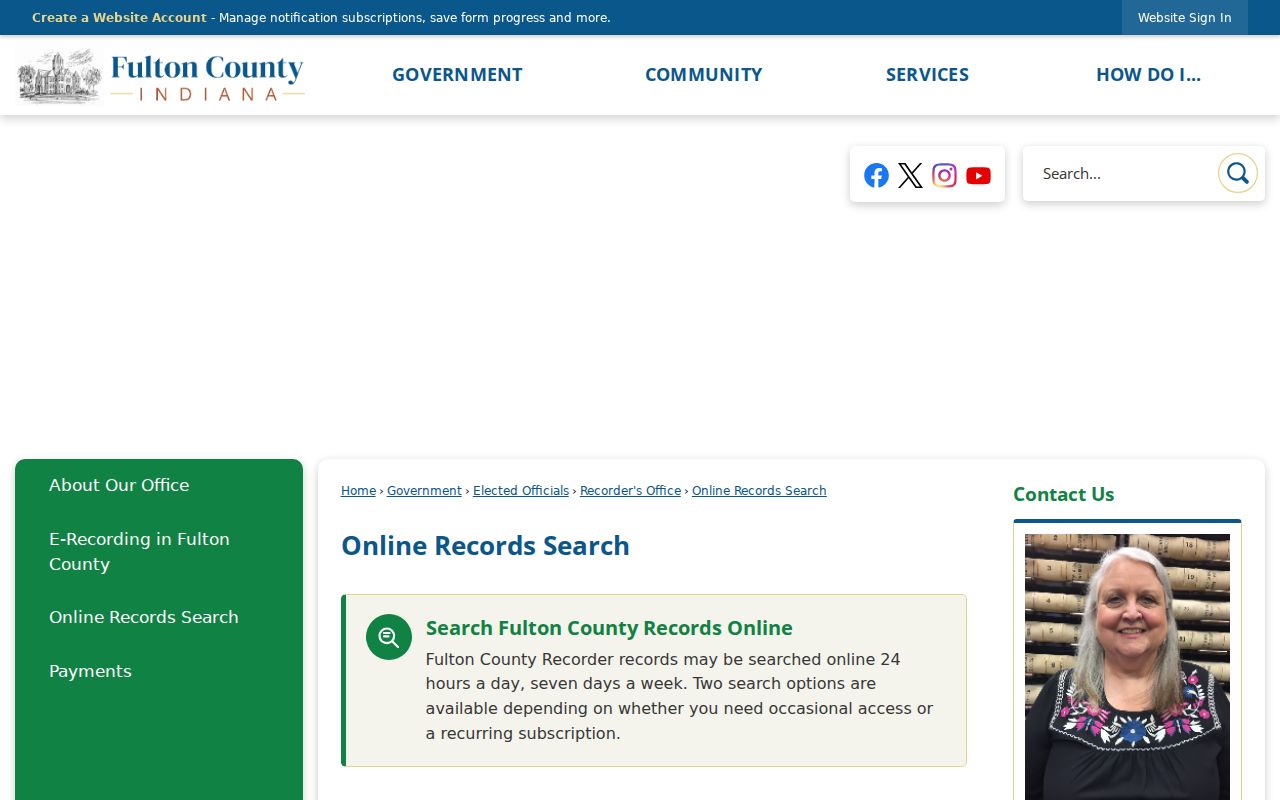
Follow the county link to reach the current vendor. Save the search date and coverage statement with your chain notes. A saved screen only aids the index; the instrument image carries the names and land wording that matter.
How Far Fulton Owners Reach
Fulton County property records run deep. The State Library's microfilm holdings reach back to the county's 1830s record era. The local Recorder keeps the original deed responsibility. Some chains predate a subdivision. Working those means tracing lot-and-block descriptions back into the parent tract. Patents and federal land sources can matter at the earliest end. The transition itself, though, has to be proved with the deeds. It cannot be guessed from a surname on a plat map.
Honest uncertainty belongs in any former-owner search. A missing deed image means you should stop and dig. So does a name collision. So does a legal description that shifts without explanation. The Recorder provides access to existing records but does not perform the title search. When completeness matters, Fulton County's stated route is a title company, abstractor, bank, or independent searcher. You can also examine the deed records yourself in person.
Lawful use. Trace Fulton County previous owners for house history, estate work, and property diligence. Never use old or current addresses to track, harass, or harm a person.
Use Fulton Maps and Directories Without Mistaking Occupancy for Title
Maps and directories can fill gaps that deed records leave open. The Indiana State Library's Fulton holdings include a 1920 property-owner map, later plat books, and Lake Manitou material. It also holds city street maps. Rochester directories survive for several years. The Fulton County Historical Society adds newspapers, obituaries, census, school, cemetery, and family-history files. Together these sources tie a person, business, building, or old address to a period of time.
None of that proves ownership. A directory entry or newspaper mention is an association, never a conveyance. Treat it as a lead. Build your names and dates there. Then confirm each transfer in the property records. Use the grantor and grantee index, the deed book, a tract book, a probate file, or another recorded instrument. Keep spelling variants and old addition names at hand. The term that cracks a historic index rarely matches today's tax-card address.
Keep a separate row for every transfer and unresolved gap.