
Inside Fulton County Tax Records
Fulton County property tax records divide the tax story among the Assessor, Auditor, Treasurer, and state Department of Local Government Finance. The Assessor values property as of January 1. The Auditor helps maintain boundary and transfer-side data, deductions, special assessments, and distributions. The Treasurer's current county-linked route, LowTaxInfo, is the place to confirm bills and payments. The WTHGIS card combines convenient reference tabs, but the county warns that its public data may not be current or legally sufficient.
| Field | What It Shows | Where |
|---|---|---|
| Gross assessed value | Land plus improvement value for an assessment year | Assessor, WTHGIS, DLGF |
| Deductions | Homestead, mortgage, and other posted reductions | WTHGIS and Auditor |
| Bill and payments | Spring/fall amounts, periods, and payment entries | LowTaxInfo and Treasurer |
| Tax district | The local district used in tax calculation | Tax list and Treasurer |
| Warning or judgment | A lead requiring current office confirmation | Treasurer records |
Indiana's anchor is market value-in-use. Real property sits at 100% of that standard under mass appraisal built from common data and valid sales. That figure is not a recorded sale price. Nor is it the taxable amount. Deductions and tax-cap rules can move the final bill away from gross assessed value, and each term gets untangled in the Fulton County property value guide.
Fulton County's Current Tax Route
Fulton County's Online Records Search page is the right first stop for current tax questions. It points to the Treasurer's billing route. The Fulton County LowTaxInfo entry carries the present bill lookup. Vendor addresses can shift over time. Entering through the county's own page therefore spares you a stale bookmark. The older Auditor and Treasurer system still helps. It searches by name, address, parcel or property number, district, and tax year. It also shows bill history, judgments, and tax warnings. That system's age argues for confirming the current bill. It does not argue for tossing a solid parcel lead.
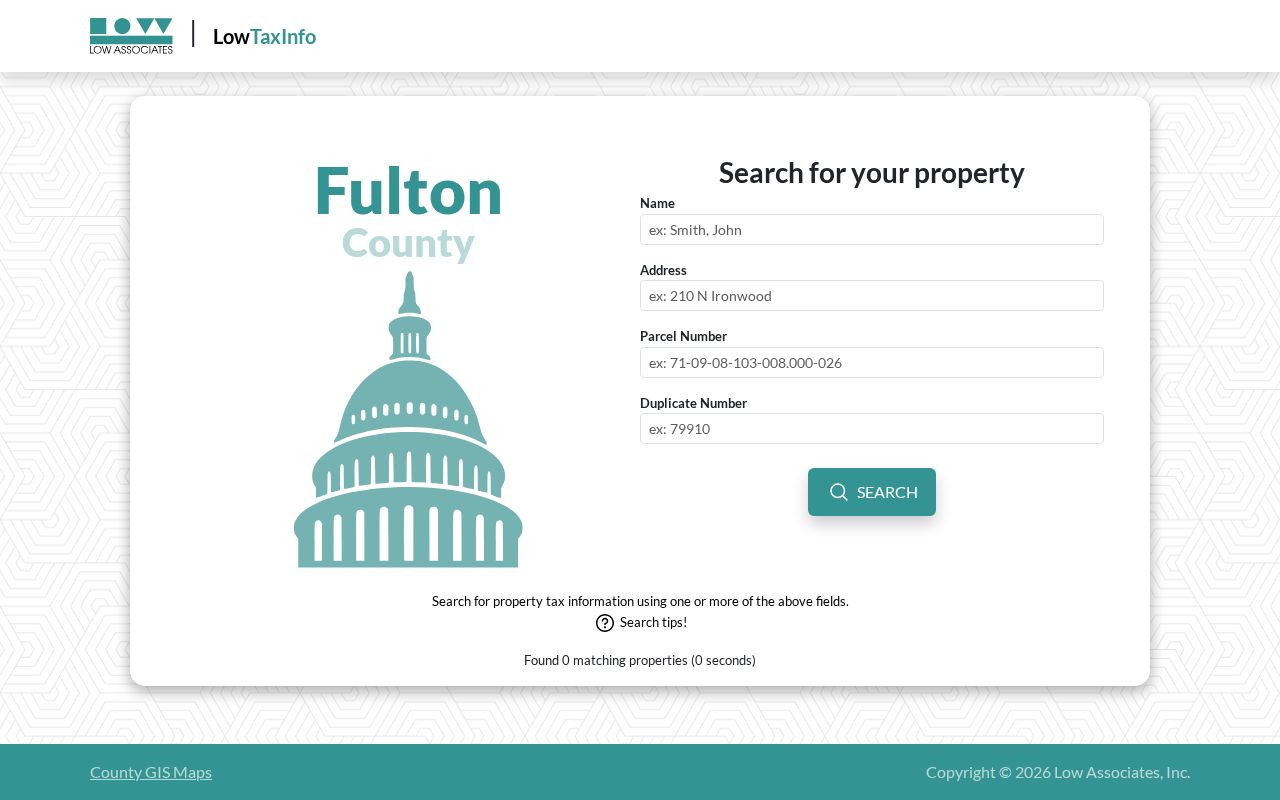
The Treasurer's office holds the official balance and issues the definitive receipt.
Search Fulton County Assessments
WTHGIS splits its card into General, Bills, Payments, Deductions, and Assessments tabs, tying the state parcel number and property number to assessment components across tax years. The county viewer can come up empty. A full search can fail too. Indiana's DLGF assessed-value search accepts a name or address as a fallback. Partial surnames or street names work better. The Details record opens on request, and an Excel download is offered, though DLGF cautions that county-submitted data varies in format.
| Search key | Best route | What to retain |
|---|---|---|
| Address | LowTaxInfo, legacy tax list, or DLGF | Exact situs and tax year |
| Owner surname | WTHGIS or DLGF | Name as displayed and retrieval date |
| Parcel/property number | County tax and WTHGIS systems | Every identifier with punctuation |
| Assessment detail | WTHGIS card or DLGF Details | Land, improvements, total, assessment year |
The DLGF assessed-value search instructions help with stubborn addresses.
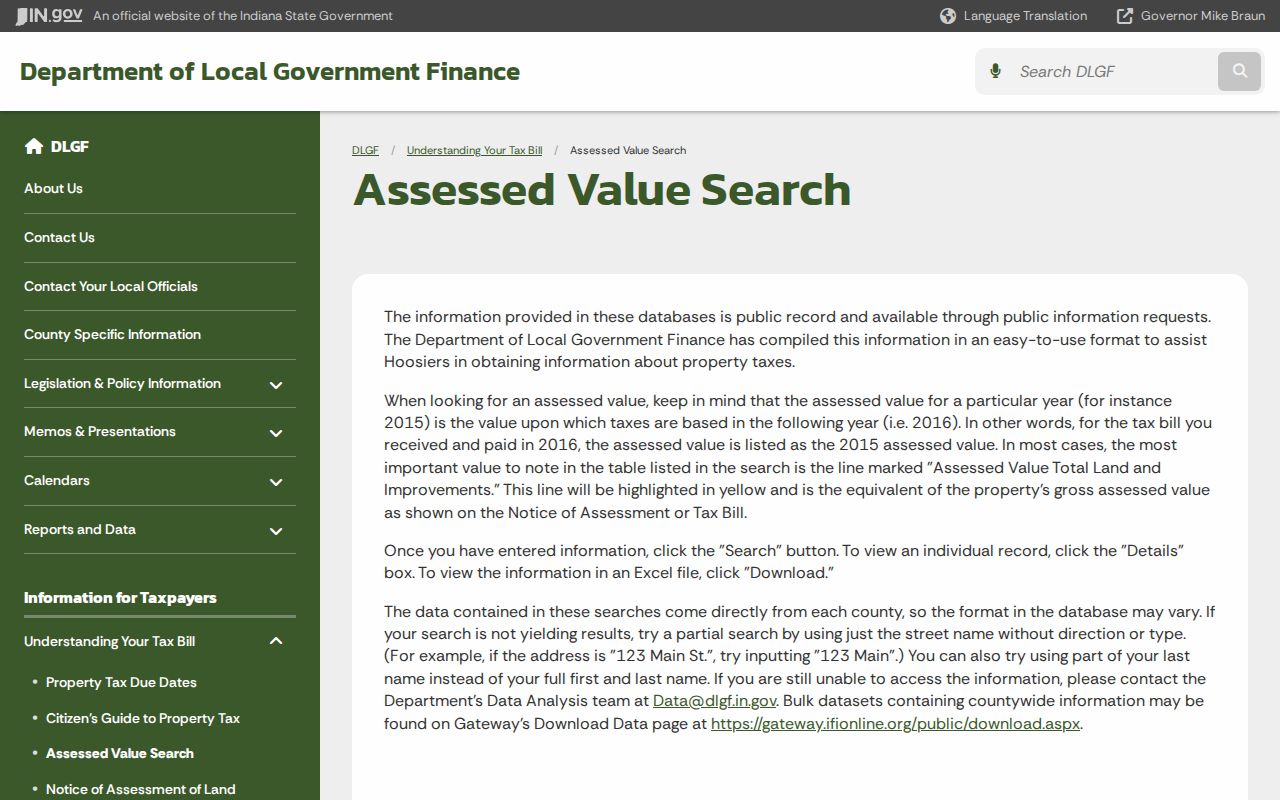
The state screen adds context; county offices answer parcel questions.
Fulton County Tax-Year Labels
One card can carry an assessment year, a payable year, bill periods, and payment dates all at once. Keep those labels separate. The Assessor's January 1 value date is not a deed recording date. A payable year is not a sale year. The sample WTHGIS card places multi-year assessment history beside tax-bill history. Those tabs describe entirely different events.
- Assessment year
- The year attached to the Assessor's value snapshot.
- Payable year
- The year in which tax based on an earlier assessment becomes due.
- Gross assessed value
- Land and improvement components before applicable deductions.
- Tax deduction
- A posted reduction in the tax calculation; it is not proof of a lien or debt.
Save a PDF or screenshot marked with the source, retrieval date, parcel number, and year labels. That record makes a later dispute easier to explain.
Look Up a Fulton County Bill
Work in sequence and mind the dates. The first dollar figure on screen is rarely the whole answer, so keep assessment data, payment status, and recorded title in separate columns.
- Open LowTaxInfo from the Fulton County Online Records Search page and search the address or accepted parcel key.
- Match the situs, owner string, and parcel number before reading spring and fall amounts.
- Record the assessment year, payable year, bill period, payment date, and posted deductions separately.
- Ask the Treasurer to confirm any warning, judgment, delinquency, payoff, or receipt that matters to a transaction.
- Market value-in-use
- Indiana's property-specific appraisal standard used for assessment.
- Tax rate
- A district and year-specific rate reported through DLGF and local tax records.
- Homestead deduction
- A deduction shown on an eligible parcel's tax record; confirm eligibility and filing with the county.
- Tax lien
- A claim for unpaid tax that requires the correct Clerk, Recorder, or Treasurer route.
Fulton County Deductions and Bills
The Deductions tab lists Homestead, Mortgage Ex, and supplemental values by year. Read those as tax fields. A Mortgage Ex entry does not prove an active mortgage lien. Lien questions belong in Recorder instruments. Some reach Clerk and MyCase records as well. Deduction questions go to the Auditor or Assessor. The Fulton County Assessor page links appeal forms, Sales Disclosure Form 46021, and exemption material. Form 46021 captures buyer, seller, address, parcel, district, sale date, and price, but a sales disclosure is not a warranty deed. Keep it out of the tax-bill column.
Keep the categories separate. A deduction changes tax treatment; a recorded mortgage or release addresses an encumbrance.
Fulton County Rates and Ratios
DLGF's Fulton County information page stacks dated budget orders, tax rates, circuit-breaker reports, ratio studies, approval letters, narratives, and land orders. Those reports give county and district context. They replace neither a parcel card nor a sale price. Match the report year to the tax question at hand. Also note whether each table is countywide, district-level, or parcel-level before quoting it. Ratio studies test assessed values against market evidence across groups of sales. They are not an automatic adjustment for one house. A parcel-level appeal stands on the property card, factual corrections, relevant sales, photographs or contractor evidence, and the official notice. A countywide ratio alone will not carry it.
Fulton County Delinquent Tax Trail
The old Treasurer page still posts judgment and tax-warning links. Current balances run through LowTaxInfo or the Treasurer. Liens work differently depending on who filed them. The Recorder's FAQ sends Indiana state tax liens to the County Clerk. Federal liens go to the Recorder and Tapestry. Federal records dated before January 1996 sit in books that require an in-person search. Hunt for releases or satisfactions too, not just the original lien.
Commissioners' minutes from February 2, 2026 carry a certificate-sale resolution covering severely delinquent accounts. That paper signals intent. It is not a parcel list. Before calling a certificate available or a parcel sold, get the current Treasurer or Commissioners notice. Then check redemption, any later deed, and court records.
| Tax question | First check | Required confirmation |
|---|---|---|
| Current balance | LowTaxInfo | Treasurer receipt or payoff |
| State tax lien | County Clerk | Release or satisfaction |
| Federal tax lien | Recorder/Tapestry | Release; in-person books before 1996 |
| Certificate sale | Current official notice | Treasurer and later record events |
Request Fulton County Tax Records
Portals fail sometimes. The office route still works. The Assessor sits at 125 E 9th Street, Suite 026, in Rochester, reachable at 574-223-2801, Monday through Friday, 8 a.m. to 4 p.m. The Treasurer's LowTaxInfo setup lists 574-223-2913. Name the parcel number, situs, and tax year. Say exactly which record you want: assessment card, bill, payment receipt, deduction record, warning, or special-assessment entry.
Indiana's Access to Public Records Act, IC 5-14-3, backs your right to inspect and copy public agency records, subject to exemptions. Ask in person or in writing. Mail and fax requests usually draw a response within seven days, and an in-person request counts as denied after 24 hours of silence. An acknowledgement may set a later production date, and agencies may charge lawful copy fees but never a search or examination fee. Keep your copy of the request, the delivery date, the response, any fee estimate, and any exemption the office cites.
Appeal a Fulton County Assessment
Begin with the Assessor. Set the notice beside the current property card. Indiana's Form 130 opens a review by the Property Tax Assessment Board of Appeals. Fulton's Assessor page links Form 130, Form 131, appeal facts, Sales Disclosure Form 46021, and supporting materials. Identify the parcel and assessment year. State the claimed error plainly. Attach evidence that fits the issue: incorrect characteristics, relevant sales, an appraisal, photographs, or repair estimates.
Timing matters. Indiana's ordinary filing rule is June 15 of the assessment year, or 45 days after a notice issued later than May 1. Go by the date on your notice and confirm the live deadline with the Fulton Assessor before filing. A friendly chat with staff never substitutes for a timely form when a formal appeal is required.
Appeal window. File Form 130 by the applicable June 15 or 45-day deadline and preserve proof that Fulton County received it.