
Decode Fulton County Property Value
Fulton County property value records contain numbers created for different purposes. The Assessor determines market value-in-use as of January 1 under Indiana Department of Local Government Finance rules. A sale disclosure reports consideration from a transfer. A private appraisal answers a different valuation question. Keep the record year and source beside every figure.
| Value | What It Is | Where |
|---|---|---|
| Assessed value | County's mass-appraisal value used in tax administration | Assessor parcel card and DLGF |
| Market value-in-use | Indiana standard based on a property's current use | Assessor record |
| Last sale price | Consideration associated with an actual transfer | Sale disclosure, transfer history, and deed clues |
| Land / improvement split | Allocation between land and structures | WTHGIS assessment detail |
Mass appraisal leans on valid sales, shared property data, and statistical testing across many parcels. It is not a price prediction. One buyer may pay more or less than the model suggests. Sale terms, the date, and property condition can push a single transfer away from the assessed value. Whether the deal faced the open market matters too.
Fulton's January Valuation Snapshot
Fulton County assessments carry a January 1 valuation date. That snapshot matters. A later renovation, sale, demolition, or market shift belongs to a later year, so read each parcel card with its assessment year in mind. Owner names and transfer fields refresh on their own schedule, apart from assessment work.
The Assessor follows DLGF mass-appraisal rules. DLGF's assessed-value search pulls data from counties and warns that formats vary. Partial names or addresses work there. A Details view and Excel results help too. Treat it as a second official access route, not proof that two systems update at the same instant.
Look Up Fulton Property Value
The county's WTHGIS property system is the direct route to a parcel. Search carefully. Similar owner names and mailing addresses can point to more than one tract, so confirm you have the right parcel before reading its value.
- Search by situs address, owner, or state parcel number. Match the map location and legal description.
- Open the assessment fields. Save land, improvement, and total values with the year shown.
- Read transfer history as a clue. Check a reported sale through the Recorder and DLGF sales-disclosure records.
- Compare like years and like value types. Do not set an old sale price beside a new assessment without noting the dates.
- Assessed value
- The value assigned through county assessment administration.
- Market value-in-use
- Indiana's value standard based on the property's use.
- Assessment ratio
- A measure used to test assessment levels against sales.
- Sale consideration
- The amount reported for a transfer, subject to the disclosure's terms.
- Reassessment
- A later valuation that replaces an earlier assessment year.
Fulton Value Search Screen
The live DLGF assessed-value search is the source for the image below.
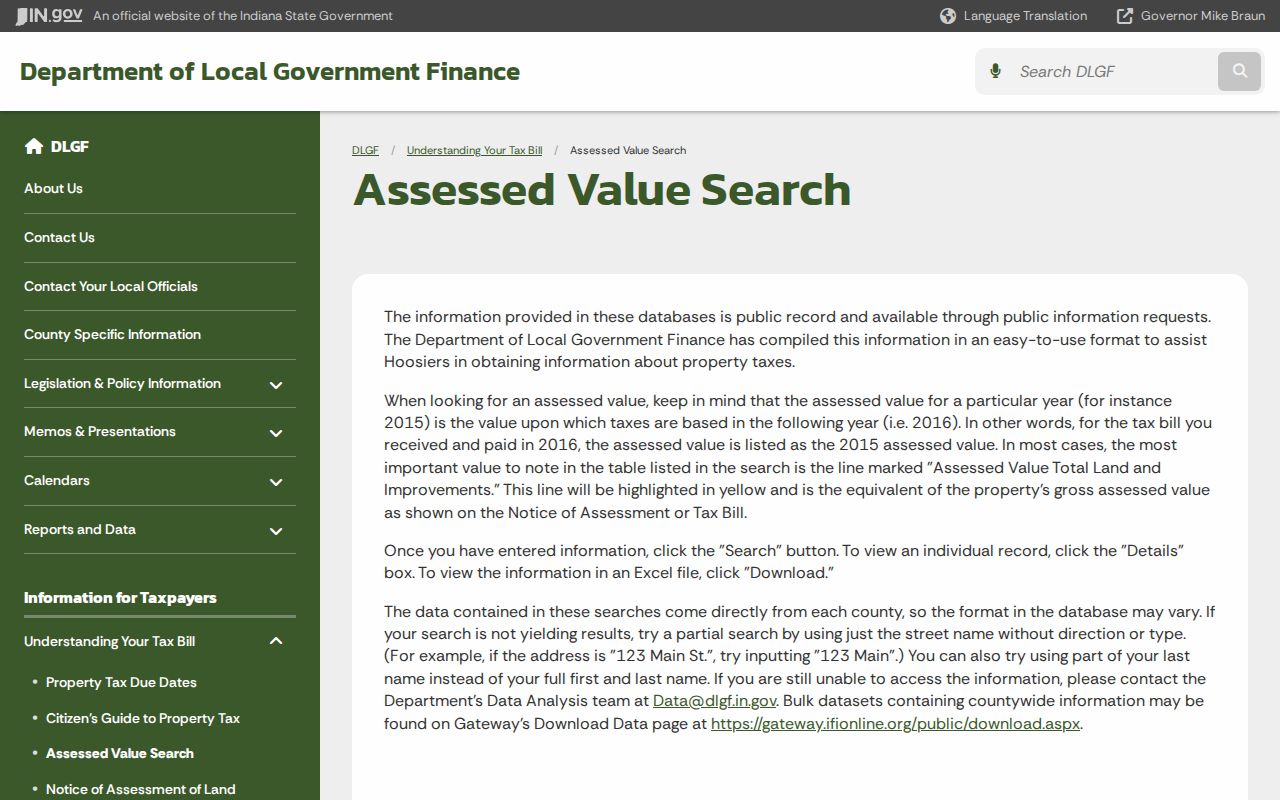
Select Fulton County first. When exact formatting fails, try partial address or owner terms, then open Details and keep the county-submitted year and parcel identifiers with the result.
Fulton Sale Price Evidence
Indiana's sales-disclosure search reaches disclosures filed after July 1, 2008. Form 46021 can identify buyer, seller, address, parcel, taxing district, sale date, and price. It also captures deduction addenda. Phone numbers stay restricted under IC 6-1.1-5.5-3(d). A disclosure is not automatically a warranty deed.
Check the Recorder when the sale matters. A deed image shows the parties, conveyance form, execution and recording data, and legal description. The disclosure contributes the reported consideration. The Recorder's Tapestry and Laredo access covers the modern index. Neither source turns an old price into current value.
Note: A non-market family, estate, correction, or entity transfer may carry consideration that is poor evidence. That consideration is weak proof of open-market value.
DLGF Checks Fulton Assessments
Ratio studies compare assessments with qualifying sales. The DLGF Fulton County page publishes dated ratio studies, land orders, budget orders, rates, cap reports, approval letters, and narratives. Those countywide reports offer context. They are not a private appraisal of one parcel.
Use the correct report year. A 2026 county report may discuss assessments or fiscal measures drawn from a defined period. Never move a countywide statistic onto one house without checking the report's scope and the parcel's record.
Value Differs From Taxable Amount
An assessment field is not the final bill. Deductions and exemptions can change the amount used in tax calculations without rewriting the property's underlying assessed value. WTHGIS shows exemption information. The Assessor links Form 136 materials too.
Payment status, penalties, and distribution belong to the Fulton property tax records route. The split matters. A lower taxable figure reflects deductions, not the Assessor's estimate of what the real estate is worth.
Verify Fulton Values Offline
The Assessor works from 125 E 9th Street, Suite 026, in Rochester. The office answers the phone at 574-223-2801 during weekday hours from 8 a.m. to 4 p.m. Call when a property record card is missing, when the assessment year is unclear, or when a listed characteristic looks wrong. Staff can pull the existing property record. They can also explain the assessment-year detail behind it.
Indiana's Access to Public Records Act, IC 5-14-3, backs your right to see public agency records. Its exemptions still apply. Frame any request so the parcel and the record you want are described with reasonable particularity. Keep in mind that the office has no duty to build a custom appraisal. It also will not forecast what a parcel might sell for.
Limits of Fulton Assessed Value
A Fulton County assessed value is an administrative figure, not a promise of sale proceeds. It can differ from an asking price, purchase offer, insurance estimate, lender's appraisal, or reconstruction cost. Each answers a separate question with its own effective date. Same parcel, different questions.
Hire a qualified appraiser for a purchase or legal valuation, disclosing the purpose and date. Assessment issues take another track. Start with the county record. The state's taxpayer materials help too. Formal appeals belong with property tax records, not informal guesses about market demand.
Value vs. price. Fulton County assessed value supports taxation. It is not a sale forecast or a licensed appraisal of what the property would bring today.
Read Fulton County Assessment Changes One Component at a Time
Break a change in total assessed value into its parts. Land and improvements tell different stories. Save both figures for every valuation year on the WTHGIS Assessments tab. Note the January 1 date each covers. Then look at the card itself. Does it show a new structure, changed characteristics, a deduction, or a sale disclosure? Indiana's annual adjustment process and mass appraisal can shift a value with no new deed involved. One parcel can move differently from its neighbors after a property improvement.
DLGF's Fulton County page adds ratio studies, budget orders, and tax-rate reports for context. A ratio study measures assessment performance across qualifying sales. It is not an appraisal of one home. The statewide sales-disclosure search reaches back to disclosures filed after July 1, 2008. Form 46021 lists the parties, parcel, address, date, and consideration. A disclosure can explain a sale amount. Yet it is not automatically a warranty deed or the assessor's current market value-in-use.
Give deductions a label of their own. They change the taxable amount, not the gross assessed value. A WTHGIS field like "Mortgage Ex" is a tax deduction field. It is not proof that a lien still sits on the parcel. Confirm liens through recorded instruments and releases. The tax page handles bill, cap, exemption, and appeal procedures.
Still think the number is wrong? Save the property card and the Form 11 or other notice. Keep photographs, repair evidence, and truly comparable sales too. Fulton County links the Form 130 appeal route and states a June 15 deadline rule. The tax-record page owns that procedure, though. For value research here, identify the disputed field first. Pin down which assessment year it covers. Then decide whether the claimed comparison concerns market value-in-use, taxable value, or a sale price. A clear label keeps a sound number from answering the wrong valuation question.