
Identify a Fulton County Owner
Answering who owns this property takes two linked steps. WTHGIS gives the current tax-card name and parcel keys. The Recorder holds the recorded deed trail. Keep both sources and their dates rather than trusting whichever result looks newer.
- Search the address in WTHGIS and confirm the selected parcel's
LocationAddress. - Save
OwnerName, state parcel, property number, legal description, instrument number, and date label. - Use the owner as grantee and the instrument or legal description in the Fulton Recorder route.
- Read the newest relevant deed and check for a later deed, probate order, sheriff deed, or quiet-title event.
- For an entity, preserve its exact name and use Indiana's official business search for context.
Fulton County Ownership Sources
Each official record answers one slice of the ownership question. A careful answer states what each document shows instead of calling every listed name the owner of record.
| Source | Owner Info It Gives | Access |
|---|---|---|
| WTHGIS card | OwnerName, situs, mailing, parcel keys | Free map/card; Assessor fallback |
| Recorder index/image | Grantee and legal description in a conveyance | Tapestry, Laredo, copy, or office search |
| Clerk/MyCase | Probate, foreclosure, partition, quiet-title order | Public portal plus Clerk request |
| Indiana business search | Entity filing and registered-agent context | Official public search |
The full portal walkthrough lives on Fulton County property search. Here the tools serve a single method: identify the tax-card name, then trace it to the latest recorded ownership event. A mailing address alone proves neither residence nor occupancy.
Read Fulton County OwnerName
WTHGIS OwnerName is the public tax-card owner string. A search for Harter and Roy returned "1/2 Harter Roy A; 1/2 Leed Victor M t/c w/surv." That field can hold fractional interests and survivorship shorthand. It is not just a simple name. Preserve every party and the punctuation before hunting for the deed that explains it. The official WTHGIS owner result displays the match as recorded.
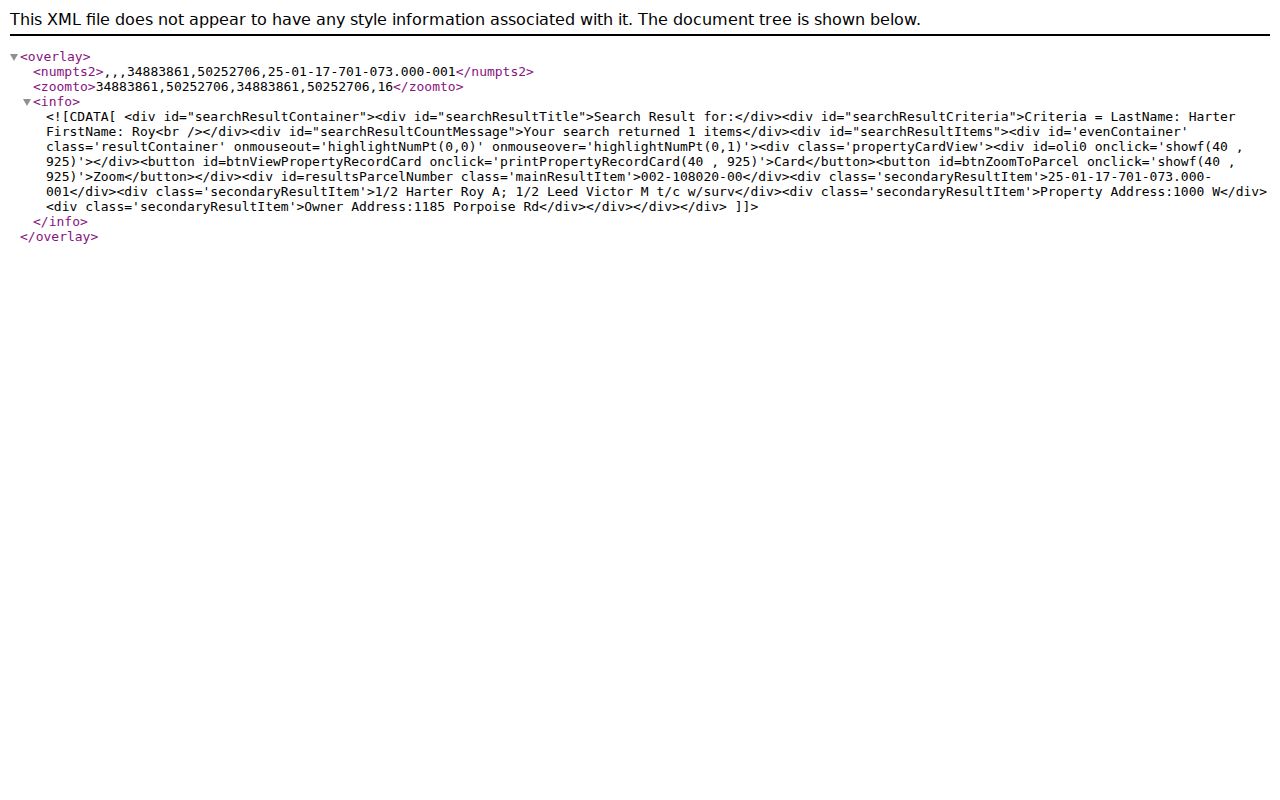
The result offers Card and Zoom actions with parcel and address keys. It stays a tax and GIS reference, not a deed.
Fulton County Owner Address Clues
WTHGIS separates LocationAddress, the situs where the land lies, from OwnerAddress, where tax mail goes. The Harter and Roy result shows Property Address "1000 W" and Owner Address "1185 Porpoise Rd." Another sample happens to match on both lines. That is coincidence, not a rule.
- Owner of record
- The name displayed by the tax roll or named as grantee in a stated deed.
- Grantee
- The party receiving an interest in a conveyance.
- Vesting
- Deed language describing how title is held, including fractional or survivorship interests.
- Situs
- The parcel's physical location.
- Mailing address
- Where owner correspondence goes; it may be outside Fulton County.
Match situs, state parcel, legal description, and instrument reference before moving to the Recorder.
Confirm Fulton County's Latest Grantee
The Recorder's Online Records Search routes occasional users to Tapestry and recurring users to Laredo. Tapestry charges $8.95 per search plus $1 per printed page. Laredo runs on monthly tiers with the same $1-per-page printing. Direct deed copies cost $1 per page and usually run $2 to $3 total. The Recorder does not perform title searches. Search the displayed owner as grantee for the acquisition. Then search the same owner as grantor for any later transfer. Save the instrument number and recording date. Save the type, party spelling, legal description, book and page, and image status too. The database is complete from January 1, 1988. One county page says deeds reach back to 1942. The FAQ says 1960, and older indexing continues. Call or visit the office for older coverage.
Date Fulton County Owner Claims
The Recorder says most documents record within 24 hours or the next business day, but Fulton publishes no fixed tax-card refresh interval. The Assessor values property as of January 1, while a deed has execution and recording dates. A new deed may appear before WTHGIS changes. That is a date-system distinction, not proof that either record is wrong.
| Confidence | Evidence |
|---|---|
| High | Latest deed image matches parcel/legal description, WTHGIS aligns, and no later conflict appears. |
| Medium | WTHGIS name and instrument appear, but deed image/current index was not reviewed. |
| Low | Only a mailing line, old directory, snippet, or historic owner map is available. |
Cite the source office and when you pulled it. A tax bill, a value card, or a mailing field proves nothing about title on its own.
Trace Fulton County Entity Owners
An owner string may name an LLC, trust, estate, or representative. It may also name spouses or parties with survivorship language. Search it exactly as written. Then test punctuation variants and related people from the deed. Indiana's official business search can explain public entity filings. But a registered agent is not automatically the beneficial owner of the land. Estates and court-driven transfers need another layer. Search MyCase narrowly for Fulton court, parties, case status, and dates. Probate may explain a representative's deed. Foreclosure may explain a sheriff deed. Quiet title may explain a later instrument. Online documents vary. So request missing public orders from the Fulton Clerk at 815 Main Street, 574-223-2911.
Request Fulton County Owner Records
When online search fails, use the office. The Recorder provides index and deed-copy access at 125 E. 9th Street, Rochester, 574-223-2914. The Assessor sits in Suite 026 and answers card questions at 574-223-2801, weekdays from 8 a.m. to 4 p.m. For older work, look to archived volumes. Recorder books and State Library microfilm hold a tract book from 1834. Deed books and indexes date from 1836. A narrow request under Indiana's Access to Public Records Act, IC 5-14-3, should identify the parcel, legal description, party, instrument or date range. It should also name the record wanted. Ask about fees and certified copies. No office must create a new ownership analysis for you.
Protect Fulton County Owner Privacy
Public access does not justify building a personal dossier. Indiana's Address Confidentiality Program offers substitute-address and forwarding safeguards for qualifying survivors, and protected voter details stay confidential. Never use another database to defeat a protected address. Recorded land documents have no broad removal button, though custodians can handle statutory redaction, index corrections, or a court order. Fulton's free Property Fraud Alert watches submitted names against new recordings and sends email, phone, or text notices. It neither prevents recording nor decides fraud. It simply prompts review with the Recorder.
Limits of Fulton County Owner Results
A public card has limits. It cannot prove who lives at an address. Nor can it show whether every interest was conveyed or a lien released, since a deed index may omit details that appear only in the image. A probate or court order may explain a transfer that a name search misses. WTHGIS warns its data may not be current. It is not legally sufficient either. Before any purchase or title decision, a qualified title professional should examine the full chain and its exceptions.
For earlier holders, start with Fulton County former owners. For a deeper look at the present tax-roll field, turn to current property owner. The strongest answer to who owns this property names the parcel, the record type, the field, the date, and the confirming instrument.
Lawful use. Use Fulton County owner records for property research, purchases, estates, and boundary questions,never to stalk, harass, intimidate, or expose a protected address.
A Fulton County Owner Confidence Check
Treat ownership as a confidence judgment built on dated evidence. Confidence runs high when the latest deed image carries the same legal description, the WTHGIS OwnerName agrees, and the Recorder and court searches show no later conflicting transfer. It drops to medium when the card lists an owner and an instrument clue but the deed image has not been reviewed. It falls to low when the only clue is a mailing address, a directory entry, a search snippet, or a historic map.
Trusts complicate the picture. So do estates and business entities. Survivorship language matters too. Each demands the exact recorded wording. The Indiana business search can confirm an entity's public filing and registered agent, though that agent is not automatically the property owner. MyCase may supply probate, foreclosure, partition, or quiet-title context, yet not every document is online. When identity affects a purchase, an inheritance, or a legal claim, order the relevant recorded copy. Let a title professional handle it. Never convert a public card into a title opinion.
If the portal route fails, work the full access chain. Call the Recorder for index help and deed copies. Ask the Assessor about the tax-roll field. Request court documents from the Clerk when MyCase does not display them, or make a reasonably particular IC 5-14-3 request for an existing record. Include the parcel number, the situs, the legal description, party spellings, and a date range. Those details let staff locate the record fast. Such requests do not ask the office to run a title search or create a new ownership report.
Verification should follow the land, not merely the name.